Showing posts with label AOP. Show all posts

Tuesday, October 02, 2012

Don’t do it!


We used to be taught that, by spending enough time thinking about a problem, we would come up with a "perfect" model, one that embodies many interesting properties (often disguised as principles). One of those properties was stability, that is, most individual abstractions didn't need to change as requirements evolved. Said otherwise, change was local, or even better, change could be dealt with by adding new, small things (like new classes), not by patching old things.

That school didn't last; some would say it failed (as in "objects have failed"). At some point in time, another school prevailed, claiming that thinking too far into the future was bad, that it could lead to the wrong model anyway, and that you'd better come up with something simple that can solve today's problems, keeping the code quality high so that you can easily evolve it later, safely protected by a net of unit tests.

As is common, one school tended to mischaracterize the other (and vice-versa), usually by pushing things to the extreme through some cleverly designed argument, and then claiming generality. It's easy to do so while talking about software, as we lack sound theories and tangible forces.

Consider this picture instead:


Even if you don't know squat about potential energy, local minima and local maxima, is there any doubt the ball is going to fall easily?

Wednesday, February 01, 2012

Turn that If into a When

I've been absent for a few months now. The thing is, I'm spending my little free time writing a non-trivial Android app. Of course, I'm also taking thousands of notes on software design, ready for a comeback :-). Anyway, staying away from my blog so long is kinda painful :-), so here I am with a short post, inspired by a very simple design choice I had to make.

When you start my little app for the first time, you get an EULA screen. If you accept the agreement, I'll initialize an internal database with some data and bring you the main screen. Ouch, did I say "if"?

Object-oriented programming was supposed to save us from switch/cases (replaced by polymorphism), and an if/else is a switch/case by another name. However, things like "if you accept the agreement" don't fit so well with polymorphism. You can make them fit, but it's not their natural shape. So we end up with just another (fat) controller.

On the other hand, perhaps I'm just saying it wrong. What if I change it into "When you accept the agreement..."? I don't know about you, but that instantly speaks "event" to me. Now, once we stop thinking about "conditions" and we think about "events", a few things happen:

- We can actually implement the concept on top of events if our language/library is event-based.

- We can fall back to the inner interface idiom, if we're in Java-land.

- We may even think aspect if we're bold enough.

Indeed, back in 2008, I wrote a post about reasoning in aspects and then implementing in objects (Can AOP inform OOP (toward SOA, too? :-) [part 1]). The idea was exactly that in some cases (cross-cutting business rules) an event-based implementation could be a poor man's alternative to an aspect-based interception (the subsequent post delved a bit more into some obliviousness issues and into the concept of cross-cutting business rules as candidate aspects).

Of course, we have to recognize the opportunity for an aspect (or event) based design. Sometimes, changing the words we use to describe [ourselves] the problem makes that easier. Next time you're facing an if, try changing it into a when. It won't always work, but it's worth trying :-).

That's it for now. Time to hit the road (snow actually :-). Places to go, clients to meet. Next time, I'm probably going to start a new series here, "life without a controller", because yeah, controllers ain't OO.

If you liked this post, you should follow me on twitter!

Monday, March 08, 2010

Why you should learn AOP

A few days ago, I've spent some time reading a critic of AOP (The Paradoxical Success of Aspect-Oriented Programming by Friedrich Steimann). As often, I felt compelled to read some of the bibliographical references too, which took me a little more (week-end) time.

Overall, in the last few years I've devoted quite some time to learn, think, and even write a little about AOP. I'm well aware of the problems Steimann describes, and I share some skepticism about the viability of the AOP paradigm as we know it.

Too much literature, for instance, is focused on a small set of pervasive concerns like logging. I believe that as we move toward higher-level concerns, we must make a clear distinction between pervasive concerns and cross-cutting concerns. A concern can be cross-cutting without being pervasive, and in this sense, for instance, I don't really agree that AOP is not for singletons (see my old post Some notes on AOP).
Also, I wouldn't dismiss the distinction between spectators and assistants so easily, especially because many pervasive concerns can be modeled as spectators. Overall, the paradigm seems indeed a little immature when you look at the long-term maintenance effects of aspects as they're known today.

Still, I think the time I've spent pondering on AOP was truly well spent. Actually, I would suggest that you spend some time learning about AOP too, even if you're not planning to use AOP in the foreseeable future.

I don't really mean learning a specific language - unless you want/need to try out a few things. I mean learning the concepts, the AOP perspective, the AOP terminology, the effects and side-effects of an Aspect Oriented solution.

I'm suggesting that you learn all that despite the obvious (or perhaps not so obvious) deficiencies in the current approaches and languages, the excessive hype and the underdeveloped concepts. I'm suggesting that you learn all that because it will make you a better designer.

Why? Because it will expand your mind. It will add a new, alternative perspective through which you can look at your problems. New questions to ask. New concepts. New names. Sometimes, all we need is a name. A beacon in the brainstorm, and a steady hand.

As I've said many times now, as designers we're shaping software. We can choose many shapes, and ideally, we will find a shape that is in frictionless contact with the forcefield. Any given paradigm will suggest a set of privileged shapes, at macro and micro-level. Including the aspect-oriented paradigm in your thinking will expand the set of shapes you can apply and conceive.

Time for a short war story :-). In the past months I've been thinking a lot about some issues in a large CAD system. While shaping a solution, I'm constantly getting back to what I could call aspect-thinking. There are many cross-cutting concerns to be resolved. Not programming-level concerns (like the usual, boring logging stuff). Full-fledged application-domain concerns, that tend to cross-cut the principal decomposition.

Now, you see, even thinking "principal decomposition" and "cross-cutting" is making your first step into aspect-thinking. Then you can think about ways to bring those concerns inside the principal decomposition (if appropriate and/or possible and/or convenient) or think about the best way to keep them outside without code-level tangling. Tangling. Another interesting name, another interesting concept.

Sure, if you ain't using true AOP (for instance, we're using plain old C++), you'll have to give up some oblivousness (another name, another concept!), but it can be done, and it works fine (for a small scale example, see part 1 and part 2 of my "Can AOP inform OOP?")

So far, the candidate shape is causing some discomfort. That's reasonable. It's not a "traditional" solution. Which is fine, because so far, tradition didn't work so well :-). Somehow, I hope the team will get out of this experience with a new mindset. Nobody used to talk about "principal decomposition" or "cross-cutting concern" in the company. And you can't control what you can't name.

I hope they will gradually internalize the new concepts, as well as the tactics we can use inside traditional languages. That would be a major accomplishment. Much more important than the design we're creating, or the tons of code we'll be writing. Well, we'll see...

Friday, April 25, 2008

Can AOP inform OOP (toward SOA, too? :-) [part 2]

Aspect-oriented programming is still largely code-centric. This is not surprising, as OOP went through the same process: early emphasis was on coding, and it took quite a few years before OOD was ready for prime time. The truth about OOA is that it never really got its share (guess use cases just killed it).

This is not to say that nobody is thinking about the so-called early aspects. A notable work is the Theme Approach (there is also a good book about Theme). Please stay away from the depressing idea that use cases are aspects; as I said a long time ago, it's just too lame.

My personal view on early aspects is quite simple: right now, I mostly look for cross-cutting business rules as candidate aspects. I guess it's quite obvious that the whole "friend gift" concept is a business rule cutting through User and Subscription, and therefore a candidate aspect. Although I'm not saying that all early aspects are cross-cutting business rules (or vice-versa), so far this simple guideline has served me well in a number of cases.

It is interesting to see how early aspects tend to be cross-cutting (that is, they hook into more than one class) but not pervasive. An example of pervasive concern is the ubiquitous logging. Early aspects tend to cut through a few selected classes, and tend to be non-reusable (while a logging aspect can be made highly reusable).
This seems at odd with the idea that "AOP is not for singleton", but I've already expressed my doubt on the validity of this suggestion a long time ago. It seems to me that AOP is still in its infancy when it comes to good principles.

Which brings me to obliviousness. Obliviousness is an interesting concept, but just as it happened with inheritance in the early OOP days, people tend to get carried over.
Remember when white-box inheritance was applied without understanding (for instance) the fragile base class problem?
People may view inheritance as a way to "patch" a base class and change its behaviour in unexpected ways. But truth is, a base class must be designed to be extended, and extension can take place only through well-defined extensions hot-points. It is not a rare occurrence to refactor a base class to make extension safer.

Aspects are not really different. People may view aspects as a way to "patch" existing code and change its behaviour in unexpected ways. But truth is, when you move outside the safe realm of spectators (see my post above for more), your code needs to be designed for interception.
Consider, for instance, the initial idea of patching the User class through aspects, adding a data member, and adding a corresponding data into the database. Can your persistence logic be patched through an aspect? Well, it depends!
Existing AOP languages can't advise any given line: there is a fixed grammar for pointcuts, like method call, data member access, and so on. So if your persistence code was (trivially)

class User
{
void Save()
{
// open a transaction
// do your SQL stuff
// close the transaction
}
}
there would be no way to participate to the transaction from an aspect. You would have to refactor your code, e.g. by moving the SQL part in a separate method, taking the transaction as a parameter. Can we still call this obliviousness? That's highly debatable! I may not know the details of the advice, but I damn sure know I'm being advised, as I refactored my code to be pointcut-friendly.

Is this really different from exposing a CreateSubscription event? Yeah, well, it's more code to write. But in many data-oriented applications, a well-administered dose of events in the CRUD methods can take you a long way toward a more flexible architecture.

A closing remark on the SOA part. SOA is still much of a buzzword, and many good [design] ideas are still in the decontextualized stage, where people are expected to blindly follow some rule without understanding the impact of what they're doing.

In my view, a crucial step toward SOA is modularity. Modularity has to take place at all levels, even (this will sound like an heresy to some) at the database level. Ideally (this is not a constraint to be forced, but a force to be considered) every service will own its own tables. No more huge SQL statements traversing every tidbit in the database.

Therefore, if you consider the "friend gift" as a separate service, it is only natural to avoid tangling the User class, the Subscription class, and the User table with information that just doesn't belong there. In a nutshell, separating a cross-cutting business rule into an aspect-like class will bring you to a more modular architecture, and modularity is one of the keys to true SOA.

Thursday, April 24, 2008

Can AOP inform OOP (toward SOA, too? :-) [part 1]

Note: I began tinkering with this idea several months ago, inspired by some design work I was doing on a real-world project. Initially, I thought I could pimp up this stuff into a full-fledged article. Months came by and I didn't, so (in the spirit of my old concept of Blogging as Destructuring) I thought I could just as well say something here instead.

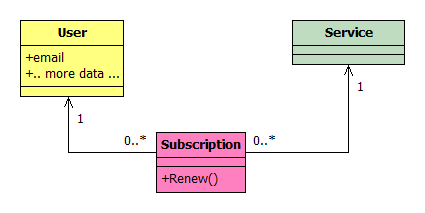
Consider a web site offering some kind of service to users. Users have to register (yeah :-), and they can then buy a subscription to several services. A simple class diagram can model this easily:


In most cases, the underlying database schema wouldn't be much different.

In a real case, there might be different kind of services, each requiring a derived class, but we can ignore this issue right now. Also, there might be several kind of subscription (time-based, pay-per-use, and so on), but again, let's ignore that issue right now, and just concentrate on time-base subscriptions.

A subscription can be renewed at any time. In the object model, this would translate into a Renew method in class Subscription. Renew could take a parameter, like the extension of the renewal. Most likely, it would add a new record to the Subscription table (to keep track of the whole subscription history for that user), and possibly create a new Subscription object. So far, so good.

Now the marketing guys come up with a nice idea: whenever you register, you can provide the email address of a friend who has already registered. If you do, everytime you renew a subscription your friend will get some kind of gift, like a free extension or whatever. This may generate a few more leads, meaning a little more business.

From a purely OO mindset, this may lead us to perform a little maintenance on the existing model. We can add a relationship from User to User to model the "friend" relationship, or we could just add a field like friendEmail (possibly left empty). At the database level, adding a field is probably easier.
We can also modify the Renew method to check for the presence of a friend in the subscribing user, and if so, invoke some Gift logic. I won't draw a modified diagram for this scenario: I guess it's just too obvious.

Now, this approach obviously works. However, you may recognize that the whole "friend gift" concept is a cross-cutting concern: it cuts through User (requiring new data) and through Subscription (requiring new logic). More on detecting cross-cutting concerns during analysis and design (and on the difference between cross-cutting and pervasive concerns) next time.

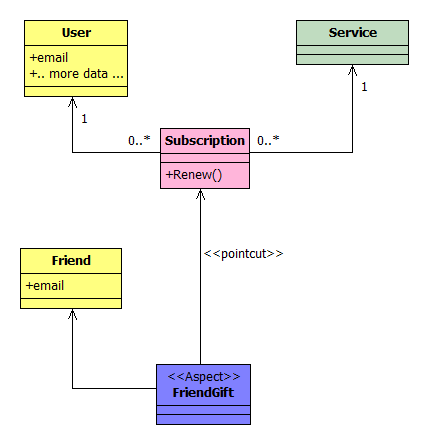
In the AOP world, we could approach the problem differently. We could define a FriendGift aspect. The aspect may add a new data member to the User class (the friendEmail), and intercept the persistence logic to save / load that data from the database. The aspect may also intercept Renew and perform the Gift logic if required.
Actually the aspect doesn't have to modify User (class and table); indeed, it would be better not to, as the persistence logic might not be easy to intercept (more on this next time). The aspect could just use a different database table to store the friend email.

Using an UML-like notation, we could model this approach as:


Interestingly, the database is probably different from the previous scenario: Friend would map to its own table.

What if we are not using an AOP-enabled language? For instance, we might be using plain old C#. Can we still borrow some ideas from the above? I believe so. In the same sense as OO thinking can inform traditional structured programming, AOP thinking can inform traditional object oriented programming.

If we don't have pointcuts, join points and aspects, we may still have events (in C#/.NET, or callback in other languages, and so on). Sure, we have to forego obliviousness (which might not be so bad: more on this next time). But we can come up with a more modular and decoupled design by reasoning along the AOP lines:


No rocket science here :-). Just a different form, same function. Different database, a more general Subscription class, unaffected by a business rule which may change at any time. Also the User class and table are left unaffected.

More on this, and a few comments on the SOA part, in just a few days (I hope :-).